Velo Lab
Designing a no-code platform for retail investors to build and test ML strategies.
At a glance
I was the founding product designer at Velo Lab, an early-stage startup building a no-code platform for retail investors to create and backtest ML-driven strategies.
The problem
Retail investors had no way to build and backtest ML-driven strategies without learning to code or hiring a quant.
The outcome
Shipped a v1 and demoed it to 5 investors, who wanted real users validated first. From there, 100 early users onboarded and quickly surfaced specific feature requests, signalling real engagement.
The Insight
The idea for Velo Lab came from the founder's own experience as a consultant to retail investors. He'd built a strategy-testing structure for himself, and investors kept asking him to build variations of it for them — different flavours of the same underlying model, tweaked for their own ideas.
That repeated demand pointed to a bigger gap: retail investors had real investment ideas worth testing, but no way to test them without either learning to code or hiring someone like him to do it for them. Even when people taught themselves enough to try, strategies could look highly profitable on paper due to overfitting but actually lose money in practice.
That became the founding thesis: build the guardrails and technical infrastructure into the product itself, so retail investors could focus on their strategy ideas without needing the data science background to avoid the mistakes that made self-built models unreliable.
How I approached it
Guardrails: constraining inputs
Setting up walk-forward validation requires choosing in-sample and out-of-sample day ranges — a concept most retail investors have never encountered, with constraints that aren't obvious just from looking at an input field.
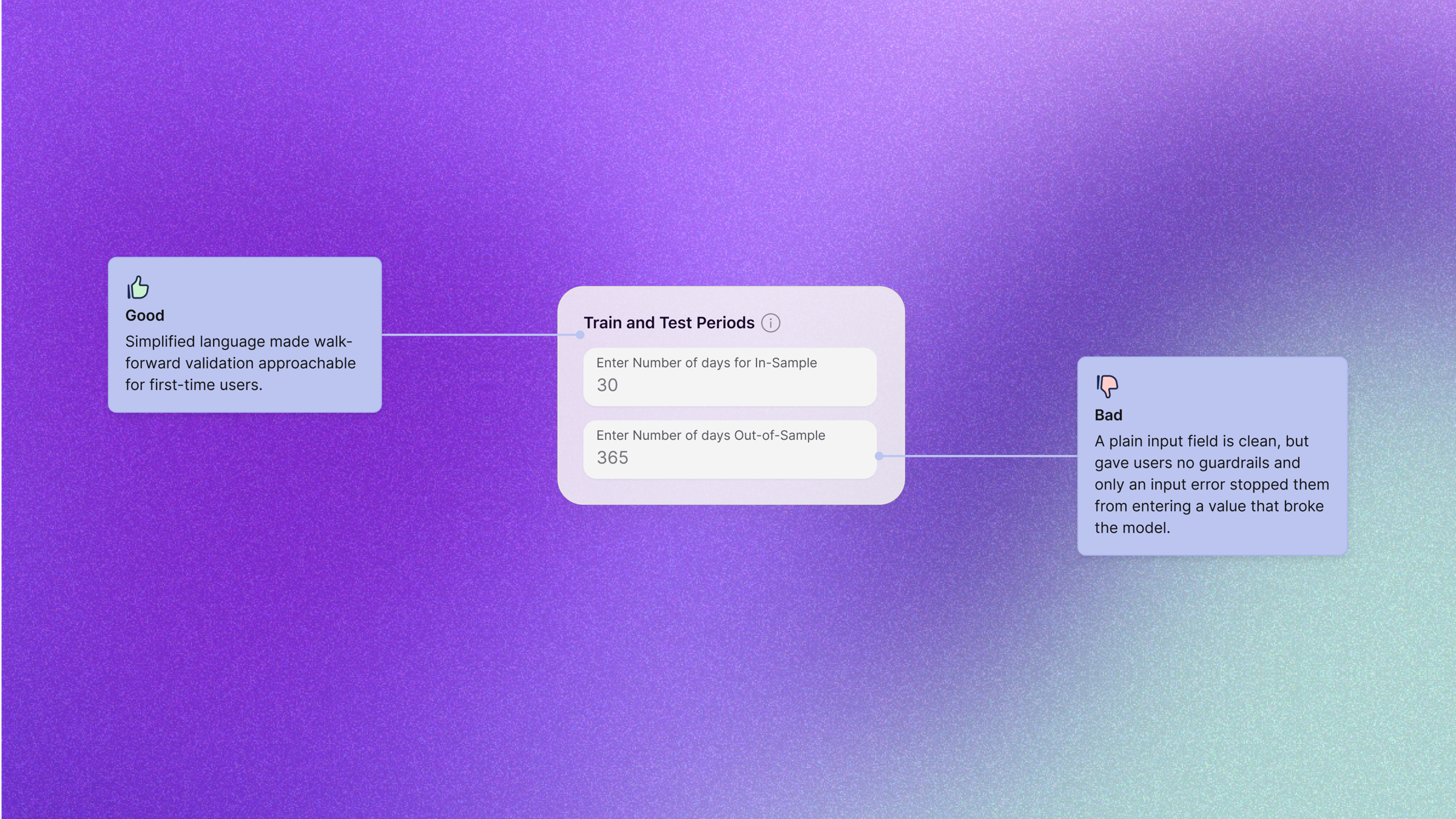
First version: plain input field
Users typed a number directly into a field for in-sample and out-of-sample days.
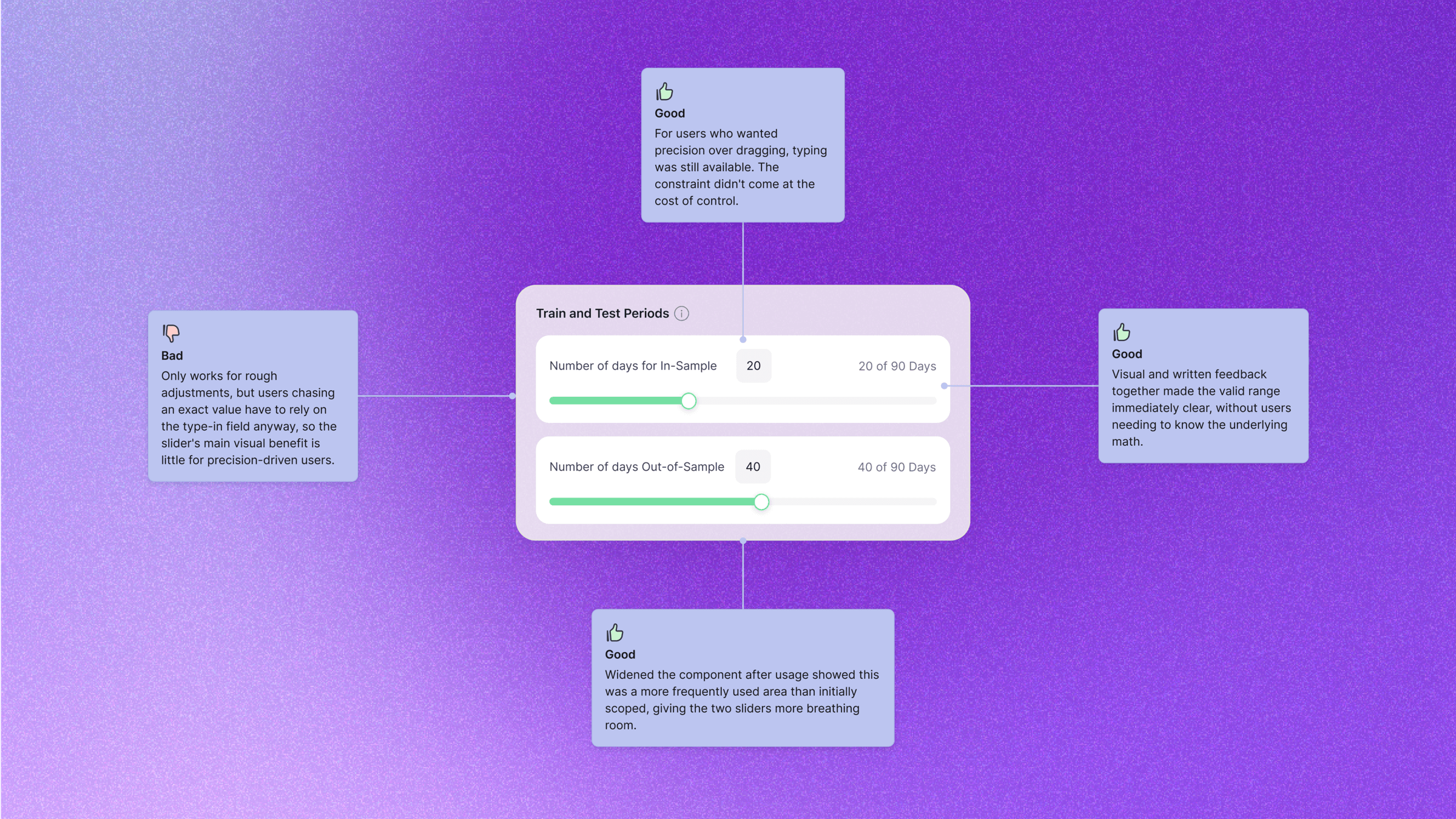
Later version: constrained slider
Replaced the open text field with a slider bounded to a valid range, paired with a live "X of 90 days" label and an optional type-in field for precision.
Layout: setting parameters vs. seeing results
Another key decision was the layout of this tool. The workflow needed users to set data and parameters, run a strategy, see results, then easily go back and tweak their inputs. Where the parameters and results lived relative to each other became a key layout decision.
Option 1: Full-screen result
The first option I thought of would have the user set the parameters and then run a strategy. This would replace the parameter panel entirely with a full results screen.
Option 2: Side-by-side panel
The second option was one where the parameters stayed visible in a persistent panel alongside results, so users could see their choices and the outcome at the same time.
Final Direction
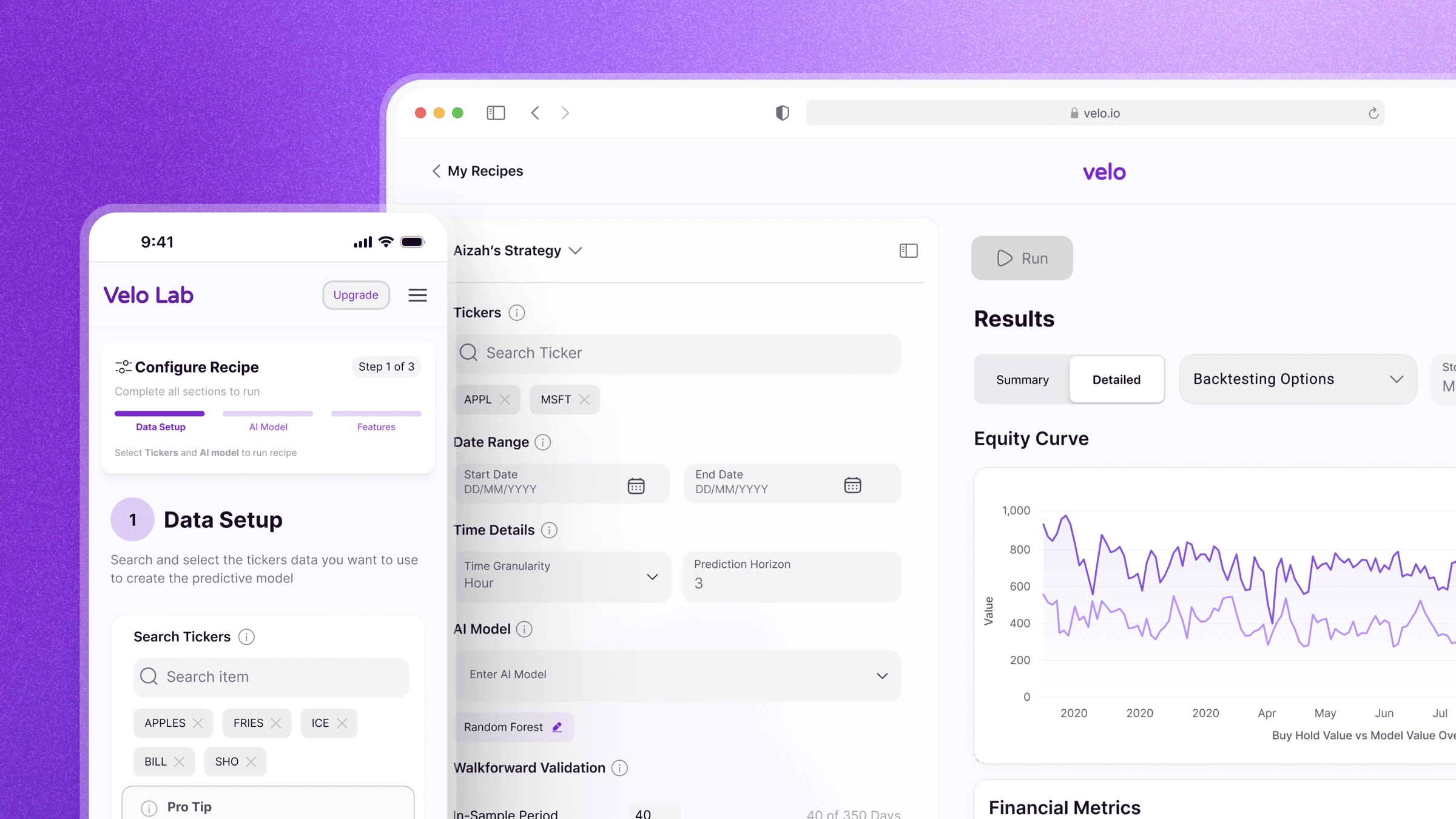
The desktop tool brought the full workflow into one screen. Setting up data, tuning the model, and reviewing results side-by-side, so users could always trace an output back to the choices behind it. The mobile version broke the same workflow into a guided, step-by-step flow with contextual "Pro Tips" at each stage — a deliberate shift from desktop's all-at-once layout, since a smaller screen meant users needed more structure and less to hold in their head at once.
Velo Lab was desktop-first, but the team needed a mobile view fast to gauge feasibility. I used UX Pilot to generate a first pass at the mobile layout, which let us evaluate what would and wouldn't translate to a smaller screen without spending design time building it from scratch.
I also used UX Pilot to quickly mock up potential results views, giving the founder something concrete to react to and get early buy-in on direction, before investing further design time into a single approach.
I'm constantly trying to improve my portfolio. Give me a thumbs up if you made it to the end of this project and enjoyed looking at it.